Showing posts with label bédé. Show all posts

Thursday, February 13, 2014

New comic book story

I’m finishing up my two-page contribution to Éditions Trip’s upcoming release of Trip #8. As you can see from the page below, it is about an astronaut floating out of control in space. This short piece is the prologue for a longer work I have outlined and it sets the ontological basis for magic in that graphic novel’s universe (more on this as it develops).
An obvious inspiration for the astronaut drawings was NASA’s photographs of the first American spacewalk.
The word captions were removed for this posting to provide further incentive to buy Trip #8 when it comes out in March.


I would like to thank Éditions TRIP for the opportunity to participate once again in one of their publications as it provided the necessary impetus to start this project.

Monday, October 11, 2010

Des chemins et des ruines

Last week I finished my second contribution to Les Fumettos du Cyclope (300 pages of cutting edge graphic narrative to be published in mid-December by Trip).  Both of my stories for this book explore philosophical themes and I’m considering writing a few more like these and publishing them together as my philosophical comics. 

My first contribution, À lire en cas de crise existentielle, is a first-aid kit for those suffering from an existential moment.  It is loosely based on an earlier short animation film became my biggest hit on YouTube.

My second contribution, Des chemins et des ruines, is also based on an early short film.  In it, I draw parallels between Socrates’ acceptance of his death sentence to remain faithful to his principles and the dilemma a young divorcé faces when she can’t reconcile her vow to live with her husband “until death” and her present situation.  This comic asks the big question: must we die for our principles?

My personal answer will always be an echo of George Brassens: “Mourrons pour des idées d'accord, mais de mort lente.”

Here are a few images from the finished story and their corresponding thumbnail sketches.  The thumbnail sketches are quite small compared to finished page (about an inch high),  I do them quickly while I’m writing the script to help me visualize how the page will look and to know if I've put too much on a given page.


page-2 

 page-3

I inked these pages on the computer using Manga Studio and Photoshop in a traditional ligne claire style.  Instead of colouring them, I scanned different fabrics and created a digital collage with them.  Originally, the line drawing was supposed to give the outline to make that fabric collage and I wanted to remove the line drawing after it had served its purpose.  However, I decided to keep them in the interest of legibility. 

 page-2page-3


The tarot cards are small paintings on canvas paper I did with acrylic, gouache and ink.

By all accounts, Les Fumettos du Cyclope will be an amazing art book and I’m thrilled to be a part of it.  I look forward to the book launch party at Le Cheval Blanc on December 18.  See you there!

Monday, September 6, 2010

Things, unfolding

What to write about this week, it seems everything is happening at once… let’s see:

Guitar controller

I’ve decided to create a guitar-like controller as an intermediary learning experience before tackling the meta-trombone project I previously described. Mr. Funk’s own guitar controller (video below) is quite remarkable.


Where he cobbled together a nice collection of hardware components (an Electrix Repeater, an Alesis AirFX and what looks like the remnants of a midi keyboard) I would prefer to keep my “guitar” small and adaptable by making it a general purpose controller for computer music.

I’d like to cannibalize a USB keyboard for parts to provide the interface between the controller’s buttons and the computer as described in this tutorial. A guitar hero strum button would be placed in the middle of the controller to be activated by the right hand. I’d place a row of buttons on the guitar neck to be activated by the left hand. I might also include some mercury switches to determine the orientation of the neck. On the software side, I’d use Bidule to interpret the commands into MIDI signals to control parameters of effects and playback of music.

One obvious use of this controller would be to use it to ‘play’ a sound or a loop as a guitar. The strum button would control a gate filter, letting sound through only when it is activated by the right hand. The left hand buttons on the neck could control a pitch shifting effect. Combining the two should result in a single string guitar that can produce sounds from the playback of any sound source.

Metatrombone and trombone controllers

My research has turned up some interesting experiments in creating electronic musical controllers based on the trombone and an extended trombone instrument called the Metabone. However, just like Nicolas Collins “trombone-propelled electronics”, both of these experiments do not use the actual trombone sounds acoustically, as I intend to do.

Trombone, non-meta variety

I’ve started playing with the Music Conservatory’s Big Band last week and I’m pretty confident this group will be swinging in no time. It feels pretty good to be playing with others again and I look forward to learning some new charts.

Bédé

Earlier this year I was invited to participate in a forthcoming (December) sequential arts publication called Les fumettos du Cyclope that will showcase experimental and cutting-edge comics from both emerging and well established artists. My two contributions will be philosophical in nature, one is a first-aid kit for an existential crisis and the other is based on one of my early short films inspired by the events leading to the death of Socrates. I have to complete everything by the end of the month, so no time to waste on that front.

That’s pretty much it, aside from the constant demands of wedding planning…

Saturday, August 14, 2010

Intuitive drawing with Alchemy

Lately, I’ve been exploring alternative drawing software. There seems to be no shortage of sketching software that seek to replicate the traditional paradigm of pen on paper. But why? Thankfully, some new sketching software is challenging that paradigm and allow us to explore all the possibilities of drawing with a computer. One software I’ve been messing around with is Alchemy.


Alchemy is a free sketching software that lies comfortably on the far side of the experimental spectrum (see demo video). Using this software, it’s very easy to create weird shapes with natural and  spontaneous motions. I view it as a discovery tool for shapes. One of the artists involved in the development of Alchemy compares it to fishing. You cast out your net and gather up all your new shapes. Since everything drawn with Alchemy can be exported as vector graphics, you can easily bring those shapes in you graphic editor of choice for further manipulation (again, that demo video is very convincing).
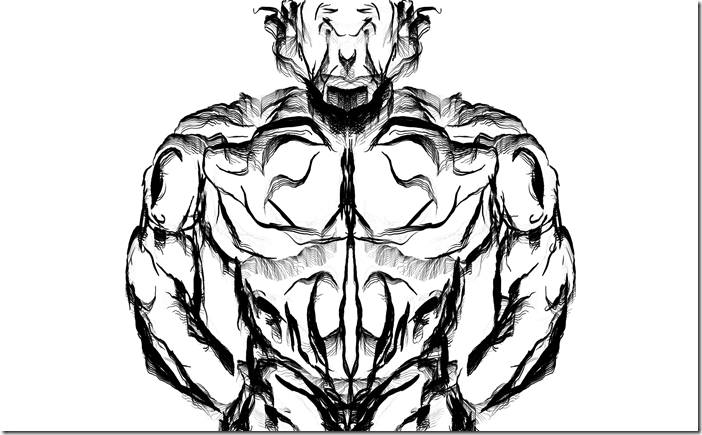
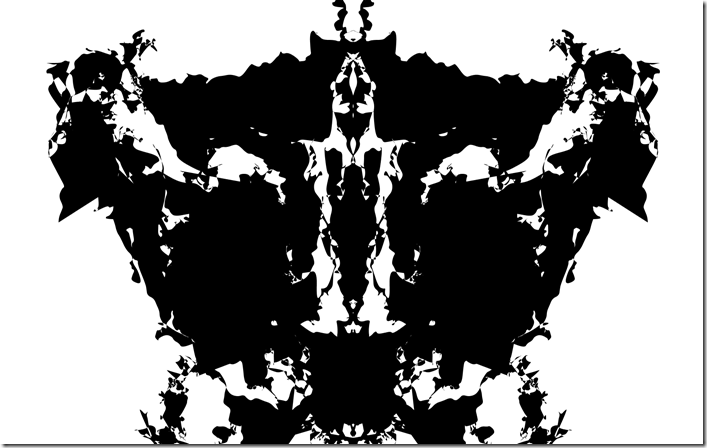
Here are some examples of drawings I quickly made with Alchemy (less than a minute).
hero samurai august 9 2010 dude
I love the simplicity of some of these drawings. It reminds me of shadow puppetry or inked line-art from a comic book page. Actually, I’ve been thinking of ways to make a comic strip with art created in part using Alchemy. Overall, my impression is that it’s a resourceful software that may prove quite useful.
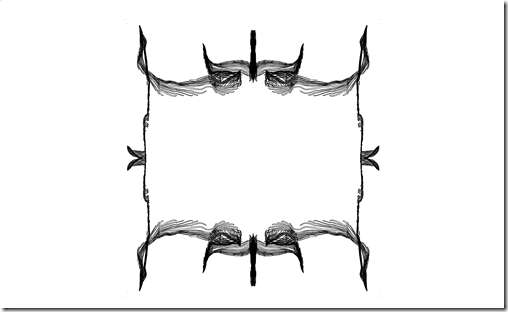
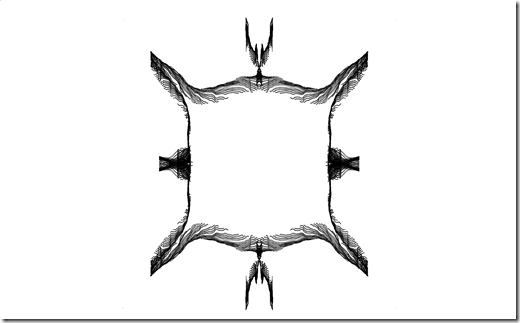
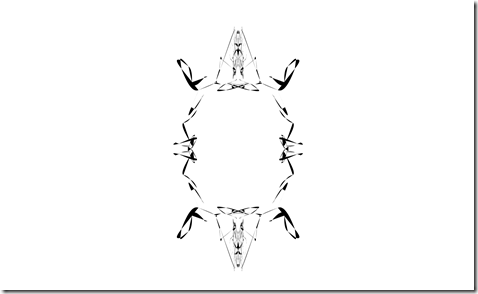
First, Alchemy can be used to create some intricate panel borders. That level of detail (and symmetry) would take me hours of work and would probably not feel as spontaneous.
border 6 bord border 1 border 2 border 3 border 4
I can also use it to create abstract background elements and textures of all sorts. Any of these shapes could become Photoshop brushes or patterns..
mountain
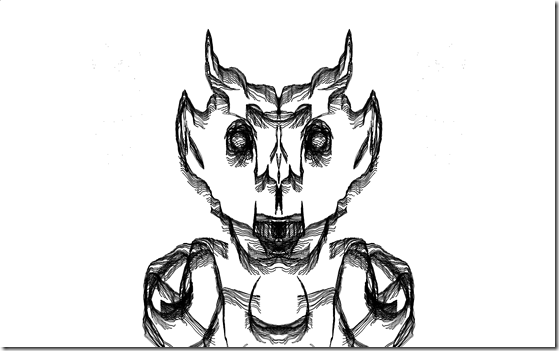
It’s also a fun way to quickly create some weird characters.
cheerleader cat character
The major hurdle facing the adoption of Alchemy for comics is the difficulty of reproducing scenery and characters with this experimental software. Maybe I haven’t mastered its interface yet, but I have the impression that, in certain modules, repeating a given brush stroke will never quite give the same result. This makes it very difficult to tell a story, since every panel will show different places and different characters. It’s not impossible; in fact this type of panel transition is what Scott McCloud called Non-Sequitur in Understand Comics. In even my limited exposure to Manga, I’ve seen entire pages that make use of only this type of transition.
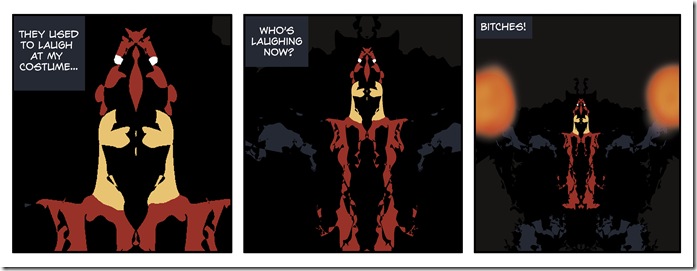
While this type of transition certainly has a place in comic books, it might prove difficult for an entire story. I think a better option would be to reuse the same drawing several times in different panels. There are at least four ways to do this.
First, I could reuse the same image by cropping close to an element of the drawing, bringing the reader’s attention to a single aspect of the drawing per panel.  Second, the entire drawing could be segmented by the panel borders. This technique is often used to great effect by Joey Comeau and Emily Horne to create A Softer World.  Third, the image could be used for a single panel comic.  Fourth, the image could be repeated to show a camera movement past an object, which is what I’ve done below.
hero-strip